Verified circularity data · from source to report

Trace every waste stream. Prove its impact.

Turn operational waste into trusted digital proof. Capture evidence at every material movement, connecting records in one traceable system — ready for reporting, procurement, circularity claims and ESG decision-making.

Get your Circularity Score
Free diagnosis + top 3 next moves
in 3 minutes
Material recovered24.8 t
CO₂ avoided56 tCO₂
Material distribution
Transformed72% · 17.9 t
In process28% · 6.9 t
Scrap0% · 0 t
Yield by stage · t

Readable by batch, site or operator.

Recovery24.8 t
Sorted21.8 t
Processed17.4 t
Scrap3.4 t
The problem

One material journey.
Five versions of the truth.

Your waste data is scattered across contractors, spreadsheets, certificates and systems. By reporting time, your team is left reconstructing what happened.

Operations
24 palletscollected
Contractor
8,420 kgreceived
Recycler
8.1 tprocessed
Spreadsheet
8.3 tdiverted
ESG report
8.2 trecycled

Which number do you report?

More importantly: how do you prove it?

Instead of reconstructing the journey, capture it while it happens.

Mind the gap

Less evidence chasing.
More confidence in every claim.

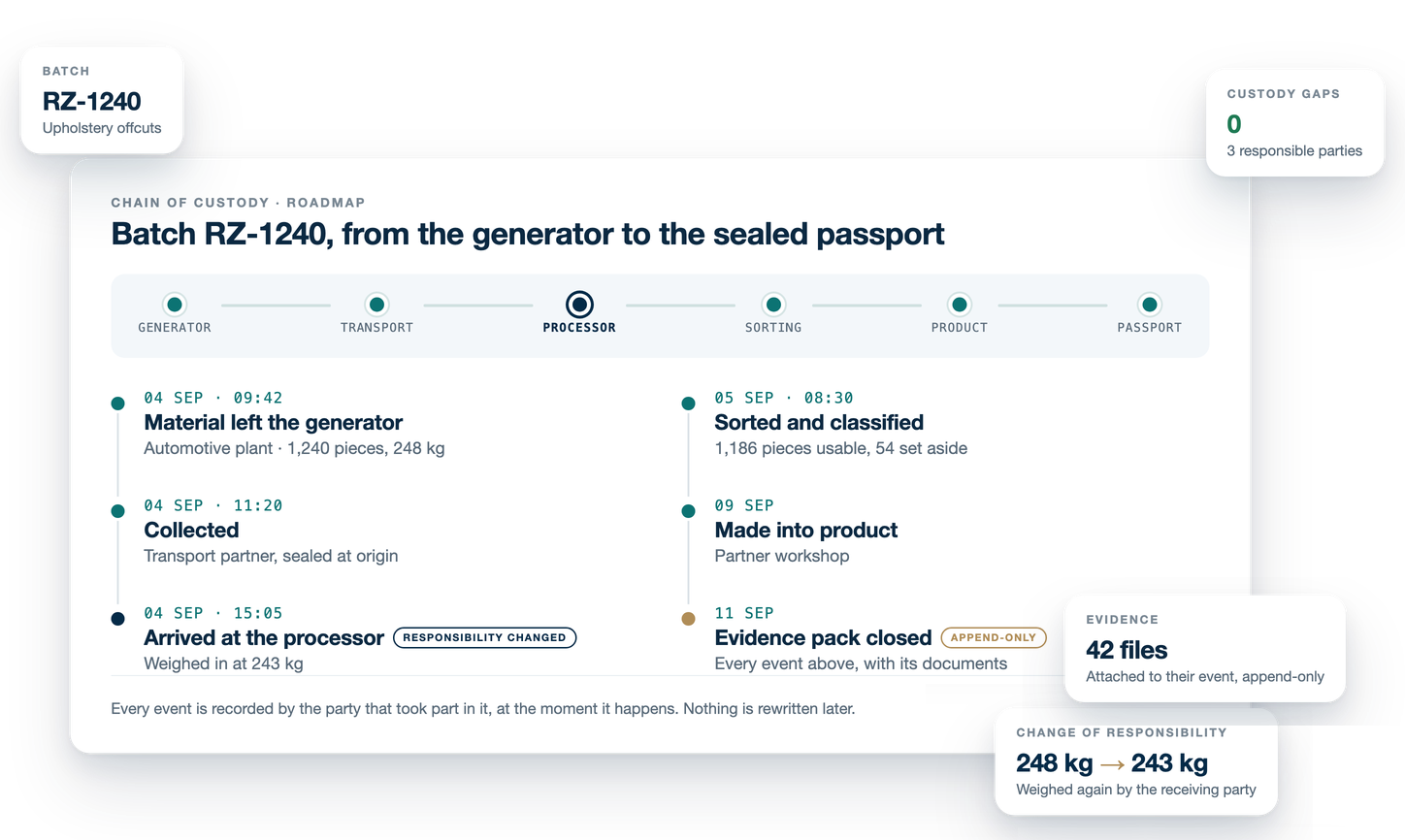
Record material origin, custody changes and processing events. Each step remains linked to the same batch, reducing the gap between operations and reporting.

  • 1IDENTIFYGain visibility of the material, its origin and key characteristics.
  • 2CONNECTDocumented handoffs between responsible parties
  • 3VERIFYEvidence that follows the material through processing
  • 4USETurn one verified record into multiple business outcomes.
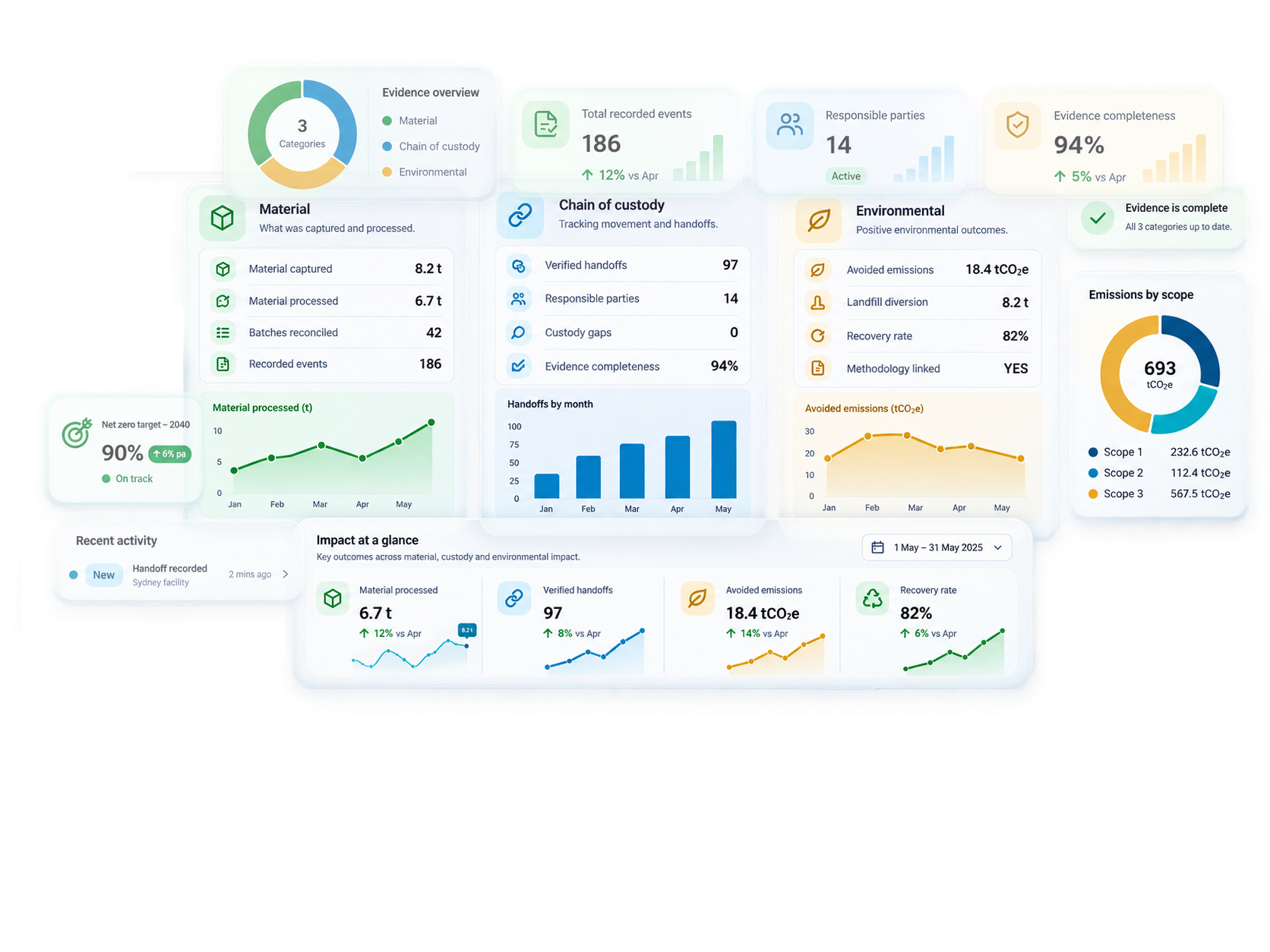
Material panel of the REZET Hub dashboard: what was captured and processed, with quantities and batches Chain of custody panel: verified handoffs, responsible parties and handoffs over time Evidence overview: batches reconciled, recorded events and evidence completeness A leadership team reviewing the impact figures on screen in a meeting room
1 of 4 · IDENTIFY

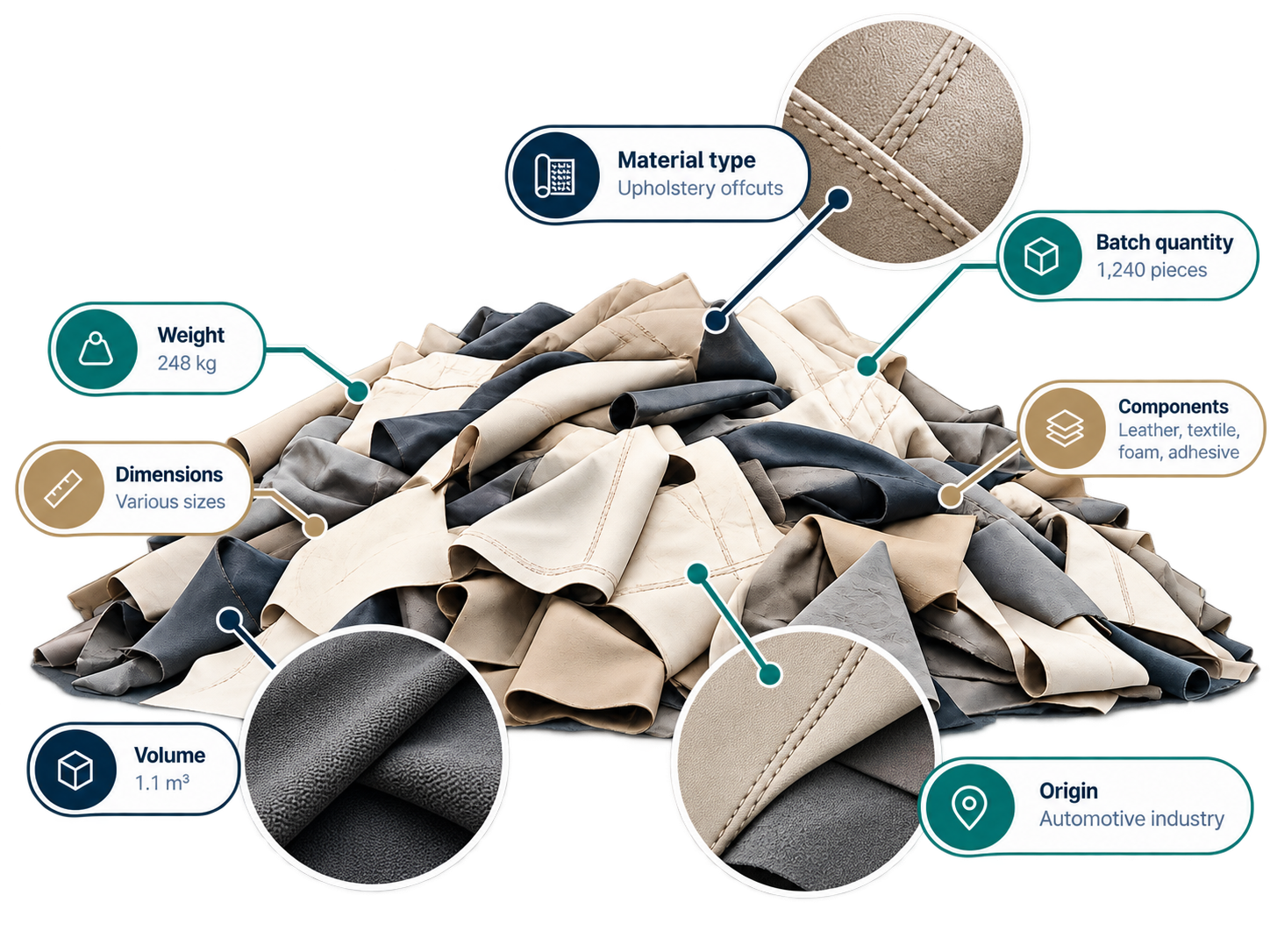
Start with a clear record of the material.

Capture what the material is, how much there is, where it comes from, which site it belongs to and who is responsible from the moment the batch enters the system.

  • CaptureBatch-level provenance from the source

So every batch begins with a reliable baseline, not an assumption.

2 of 4 · CONNECT

Keep the record connected as the material moves.

Link generators, transporters, processors and other participants to the same batch as responsibility changes.

  • TrackEach handoff adds evidence to the same chain of custody
  • Updates are captured by the people involved, when the event happens

So you can follow the material without chasing contractors or reconstructing handoffs later.

3 of 4 · VERIFY

Reconcile the record with what actually happened.

Connect movements, processing events, inputs, outputs, custody changes and supporting documents back to the original batch.

  • ReconcileEvidence follows the material through processing and recovery
  • Discrepancies are surfaced when recorded data and material movements do not align
  • Supporting documents remain attached to the relevant event and batch

So reported outcomes are supported by a complete, traceable evidence trail.

4 of 4 · USE

Turn evidence into decisions and multiple business outcomes.

Use the structured evidence for reporting, audits, procurement, circularity analysis, Digital Product Passports and other downstream requirements.

  • TraceBatch-level provenance, custody and material history in one continuous record
  • MeasureConnect inputs, outputs, transformation and recovery to support measurable material and environmental outcomes
  • ShareCreate QR-linked Digital Product Passports for authorised buyers, auditors and regulators
  • ExportPrepare structured evidence for reporting, review and audit

So one record can answer the auditor, inform the Board and give the buyer confidence.

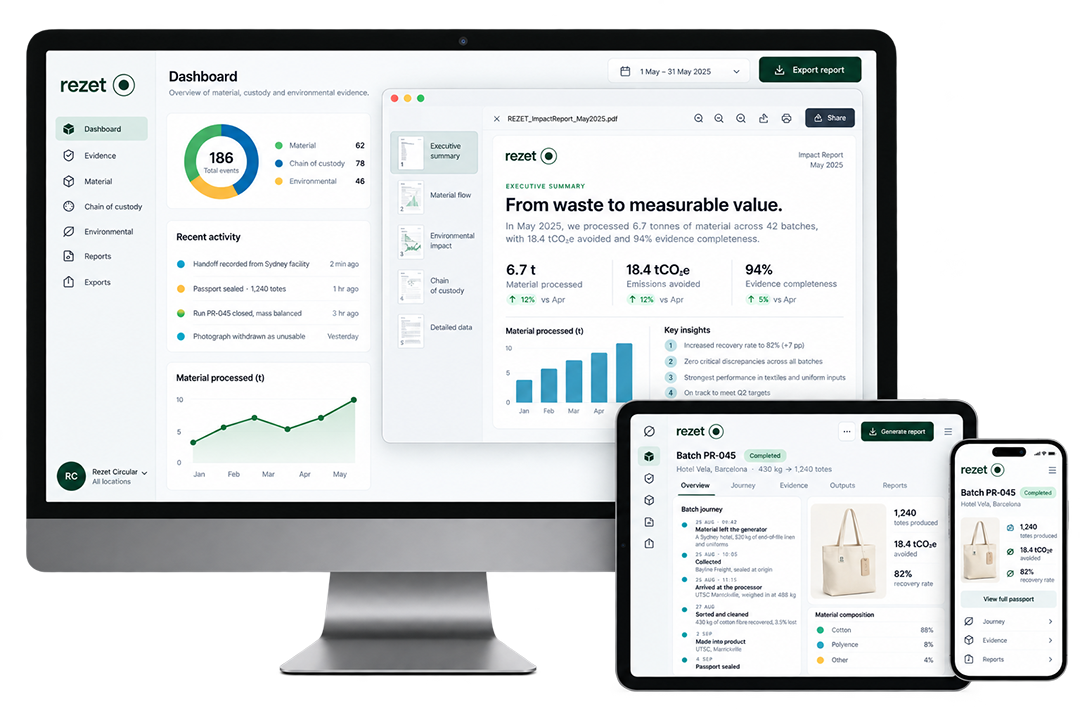
Illustration of a REZET Hub decision-ready circular data dashboard
From verified evidence to decision intelligence.

One verified record. Smarter business decisions.

Instead of reconstructing the journey, capture it while it happens. Once material evidence is structured and connected, the same record can support operational decisions, reporting and circularity improvement.

  • Review material performance by batch, site or programme
  • Identify trends, exceptions and opportunities for improvement
  • Export reporting-ready evidence from the underlying record
Why now

Claims are no longer enough.
The market is asking harder questions.

Organisations need to show where materials came from, what happened to them, who handled them and what emerged from the process.

Reporting scrutiny

Organisations increasingly need defensible source data behind sustainability and Scope 3 reporting.

Product transparency

Digital Product Passports and product-level disclosure are pushing traceability further upstream.

Claims accountability

Customers, procurement teams and regulators increasingly expect evidence behind circularity and environmental claims.

REZET Hub digital evidence and product passport visual
One platform for your whole organisation

One evidence trail. Multiple teams.

No need to rebuild the truth every time. Different teams can interrogate the same structured record without recreating the evidence in separate systems.

“Can I defend this number?”

Verifiable Scope 3 data

Report data measured per batch, with documented methodology, audit-ready.

  • GHG Protocol · Scope 3 · Category 5
  • Avoided emissions: measured, not offset
  • Methodology and chain of custody linked to every data point
EVIDENCE BEATS ASSERTION
Every reported number can be traced back to the exact material batch that produced it.

“Which supplier actually performs?”

Supplier and processor traceability, documented.

Who handled the material, when responsibility changed and what happened at each stage, all linked to the same batch record.

  • Documented handoffs between responsible parties
  • Processing events linked to the relevant operator
  • Batch-level input and output reconciliation
CHAIN OF CUSTODY
Evidence follows the material from origin through every documented change of responsibility.

“Can we safely claim this?”

Evidence can support the story.
The record comes first.

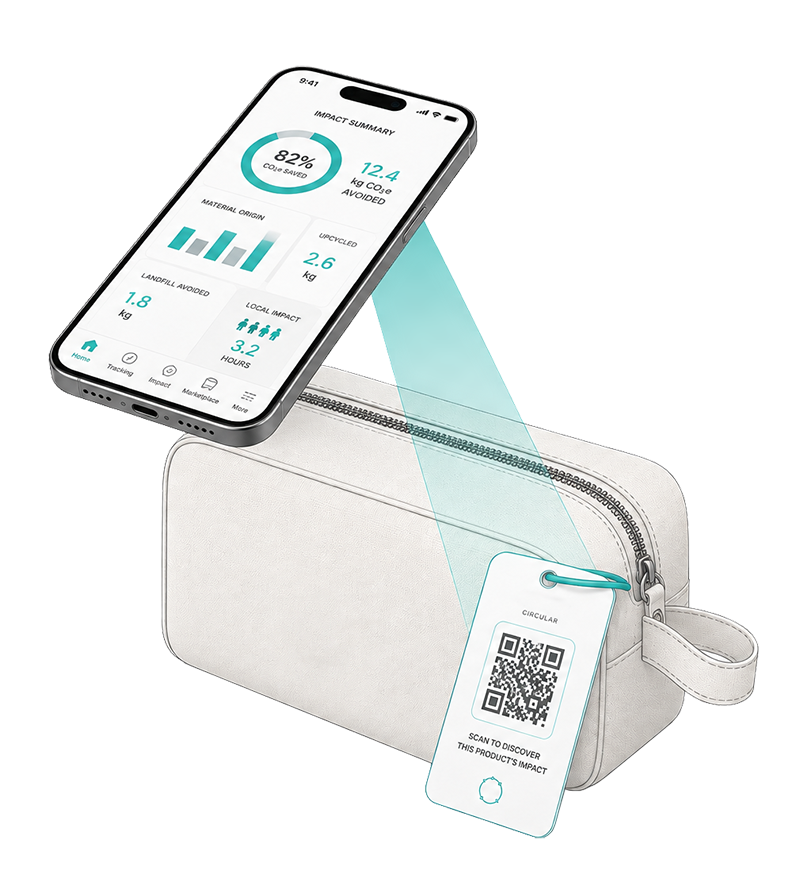
A QR-linked digital passport can expose the verified history behind a product: material origin, processing events, supporting evidence and measured outcomes.

  • QR-linked digital passport
  • Origin, processing, evidence and measured outcomes
  • A checkable record for buyers, auditors and regulators
REAL DATA. REAL IMPACT.
The QR gives authorised viewers a direct route from a claim back to the evidence supporting it.

“What happened after it left our site?”

Follow the material
without chasing contractors.

Follow every stage from handoff to processing and final destination, with updates captured along the way.

  • Handoff, movement and processing events on one timeline
  • Final destination recorded against the originating batch
  • Exceptions surfaced when the record and the movement disagree
NO MORE CHASING
The update arrives with the material, not three emails later.

Batch-level traceability

A tamper-evident, append-only record of each material batch and the events attached to it.

Evidence captured in motion

Information is created at material handoffs and processing events rather than reconstructed afterwards.

Verified handoffs

Each participant contributes evidence where responsibility changes, preserving the chain of custody.

Structured evidence packs

Batch records can be exported to support audits, compliance, sustainability reporting and customer requirements.

Reconciled material outcomes

Inputs, outputs, transformation and recovery are connected at batch level to support measurable environmental outcomes.

Digital Product Passports

QR-linked records make provenance and supporting evidence available to authorised buyers, auditors or regulators.

Digital Product Passport QR tag and verified product history on a mobile device
Digital Product Passport · DPP

Every product carries its own verified history

A QR-linked Digital Product Passport (DPP) makes provenance clear at a glance. Material origin, processing events, supporting evidence and measured outcomes remain connected to the underlying batch record — a permanent, auditable history rather than a label.

Product story
Materials
Processing
Certification
Impact
Record
Plans built to scale with your programme

Start with visibility. Expand as evidence grows.

Choose the level of access your organisation needs today. As sites, users and reporting requirements grow, REZET Hub grows with you.

Freemium

Explore

For teams beginning to map materials and understand their circular data.

  • 1 site
  • 1 user
  • Basic live waste pathway
  • Limited batch uploads
  • Basic CO₂e summary
  • ×Filtered data views
  • Basic exportable reports
  • ×Location management
  • ×API access
  • ×SSO
  • Self-serve support
Core

Operate

For organisations managing recurring batches and reports.

  • 1 site
  • 3 users
  • Live waste pathway
  • Limited batch uploads
  • CO₂e summary
  • Basic filtered data views
  • Standard exportable reports
  • 1-site location management
  • ×API access
  • ×SSO
  • Email support
Growth

Scale

For multi-site teams requiring stronger controls and Scope 3 reporting outputs.

  • 3 sites
  • 10 users
  • Live waste pathway
  • Monthly batch uploads
  • Audit-grade Scope 3 summaries
  • Filtered data views
  • Audit-grade Scope 3 exports
  • 3-site location management
  • ×API access
  • Optional SSO
  • Priority support
Frameworks

REZET Hub creates the evidence layer behind sustainability reporting, so companies can prove provenance and use that evidence for frameworks such as

Frameworks our clients report into. Mapping detail available on request — we describe what the evidence contains, not what it certifies.

01 · OWNERSHIP

The data stays yours

Records belong to the organisation that created them. Export is available at any time, in a structured format.

02 · ACCESS

Roles, not passwords shared around

Each party sees the movements it took part in. Generators, processors and brands do not share one login.

03 · REVIEW

Auditors come in as guests

External reviewers can be invited to a read-only view of the evidence trail, without moving files by email.

FAQs

Where to start?

Find answers to common questions and discover the best way to get started.

What does onboarding require?

Start with one material pathway: its origin, destination, people involved and the evidence it needs to support. We then configure locations, roles and the records required at each handoff.

Do we need to change our existing systems?

Not necessarily. REZET Hub is designed to complement existing operational, ERP, reporting and sustainability systems rather than requiring organisations to replace their existing technology stack.

How long does implementation take?

Timing depends on the first pathway, sites, users and integration requirements. We confirm the implementation plan after scoping rather than promising a generic duration before we understand the operating reality.

How is REZET Hub different from traditional reporting?

REZET Hub does not simply tell you what happened.
It helps you decide what should happen next.
Traditional reporting often relies on information entered after an event has occurred. REZET Hub is designed to capture evidence as materials move and responsibility changes, creating a stronger connection between the physical event and its digital record.
It also goes beyond reporting by acting as a sustainability decision-support tool. By analysing each waste stream, REZET Hub can identify alternative recovery, reuse, upcycling or recycling pathways, helping organisations improve circular outcomes and make more informed progress towards their zero-waste goals.

Which plan is right for a first pathway?

Explore is for one user testing one stream at one site. Operate supports a small team managing recurring batches and standard reports at one site. Scale adds multi-site controls and audit-grade Scope 3 outputs. Integrate is for advanced controls, SSO, API and broader organisational support.

Who is REZET Hub not for?

REZET Hub is not a carbon-credit marketplace, a substitute for the physical operator, or a generic reporting tool that can reconstruct missing evidence after the fact. It works best when there is a real material flow and an internal owner prepared to make the record part of operations.

Can we start small and expand later?

Yes. Start with one live pathway, then add users, sites, materials, reporting outputs or integrations as the programme grows. The right starting point is the smallest plan that can support the job properly.

Can we compare supplier with supplier?

Yes, on the record’s own terms. Handoffs are documented between responsible parties, processing events are linked to the relevant operator, and inputs and outputs are reconciled at batch level, so the same figures read supplier by supplier and site by site. Exports can be taken at any time in a structured format, for tenders, contract reviews and disputes.

What does REZET Hub record?

Batch-level material identification, documented handoffs, processing events, responsible parties and input-output reconciliation. The result is a structured trail ready for review and export.

Can the evidence support audits and reporting?

Yes. The evidence pack can support internal reporting, audits, customer requirements and Digital Product Passports. REZET Hub records the evidence; it does not replace the underlying regulatory obligation.

Does REZET Hub sell carbon offsets or credits?

No. Where environmental outcomes are calculated, they stay linked to the underlying material record, methodology and supporting evidence rather than being presented as an offset.

Who verifies the data?

Each responsible party records the handoff it took part in, and the receiving party measures the material independently on arrival and compares it against the sending party’s quantity, so any discrepancy becomes visible. Where the record and the movement disagree, the difference is surfaced as an exception instead of being smoothed over, and the underlying record is tamper-evident and append-only. Auditors and assurance providers come in as guests, on a read-only view of the trail. REZET Hub describes what the evidence contains, not what it certifies

What happens when a record is corrected?

Corrections are appended, not written over the top: every step becomes an event that is added to the record rather than replacing what was there. An auditor drilling into a claim sees the measurement, the actor, the evidence and the correction history behind it, which is why the record is never rewritten for the reader.

Are units and classifications standardised at capture?

Capture begins from a material profile selected at source, with description, quantity and photographic evidence recorded against it; the receiving party then measures the material independently and reconciles the mass. The units and classifications your programme uses are agreed at onboarding, when we configure locations, roles and the records required at each handoff.

Who owns an exception?

REZET Hub surfaces the exception and shows which party recorded which movement; it does not appoint the person inside your organisation who resolves it. REZET Hub works best when there is a real material flow and an internal owner prepared to make the record part of operations.

What does a contractor have to do?

A contractor contributes evidence only where responsibility changes. Working from a scoped link, it sees the one job assigned to it and the quantity handed over, records the outputs, photographs or weighs them and submits. There is no shared login and no second reporting workflow: each party sees only the movements it took part in.

What does this add to our own site team’s day?

At the point of movement, the person handling the material selects the material profile, captures the description and quantity, and captures photographic evidence against it. There is no second reporting workflow: REZET Hub is designed to complement existing operational, ERP, reporting and sustainability systems rather than replace them.

What happens when a handoff is missing?

Evidence is created at material handoffs and processing events rather than reconstructed afterwards, so a handoff that was never recorded stays visible as a gap in the batch trail. Where the record and the movement disagree, the difference is surfaced as an exception.REZET Hub is not a generic reporting tool that can reconstruct missing evidence after the fact: it shows the gap, it does not fill it.

Where did REZET Hub begin?

REZET Hub began inside REZET Global’s circular programmes. Real materials were being recovered and transformed, while evidence sat across spreadsheets, emails, photographs and certificates. REZET Hub was built to keep the digital record in step with the physical work.

Is REZET Hub only for companies working with REZET Global?

No. REZET Hub and REZET Global are separate businesses. REZET Hub can be used independently by organisations and circular operators. REZET Global provides one real-world operating environment in which REZET Hub’s evidence capabilities can be applied.

What languages is REZET Hub available in?

REZET Hub is available in English and Spanish, with Portuguese and German coming soon.

How does this work across different jurisdictions or states?

REZET Hub records the evidence; it does not replace the underlying regulatory obligation, and this page does not set out the rules of any single jurisdiction. Sites are managed as locations within one programme, and framework mapping detail is available on request — we describe what the evidence contains, not what it certifies. Which requirements apply at each site is scoped before implementation.