Scope 3 is fifteen categories, not one
For an operating business with physical sites, waste generated in operations is usually among the first that can actually be calculated — and therefore among the first that gets tested.
You are probably here because someone in finance said the words “Group 2” and nobody in the room was sure whether that includes you.
AASB S2 is Australia's climate disclosure standard, and it is not voluntary. It phased in by size. The standard is the same for all three groups; only your deadline moves.
The Australian Sustainability Reporting Standards sit on the ISSB base. AASB S2 is the climate one, and it is the one with the phase-in.
A mandatory climate-related disclosure regime, prepared as a sustainability report alongside the financial report. It follows the familiar four pillars — governance, strategy, risk management, and metrics and targets — and it requires greenhouse gas disclosure, Scope 3 included.
Entities that already have to lodge an annual report, once they cross the size thresholds for their group. It is not a listed-company regime: large private companies and registered schemes are captured too, which is what catches most people out.
Governance and strategy are drafting. Scope 3 is measurement, and it depends on data produced by other organisations — your transporters, your processors, your suppliers. That is the part that cannot be written in the weeks before lodgement.
For an operating business with physical sites, waste generated in operations is usually among the first that can actually be calculated — and therefore among the first that gets tested.
A single site total cannot be converted into emissions, because each material and each treatment route carries its own factor.
Recycled, recovered, landfilled or incinerated. The route is decided after the material leaves you, so it has to come back from the party that decided it.
Weighed at the gate, weighed at the weighbridge, or taken from an invoice. All three appear in practice. Only the first two survive scrutiny unannotated.
Once you have disclosed one year you have created a baseline. The second year is where unexplained movement becomes a finding.
A climate disclosure carries director-level accountability. The people signing will ask what sits behind the number before they do.
Two of three, on the consolidated numbers, for the financial year that applies to your group. Do this first: it sets your deadline.
Start with the ones where physical material moves and quantities exist. Waste in operations is usually the most tractable.
Not from a monthly summary. The unit that survives is the movement: material, quantity, party, date.
Transporters and processors write their own leg, so the outcome is reported by whoever produced it.
The year before you report is the cheapest year to fix your data, because nothing has been published yet.
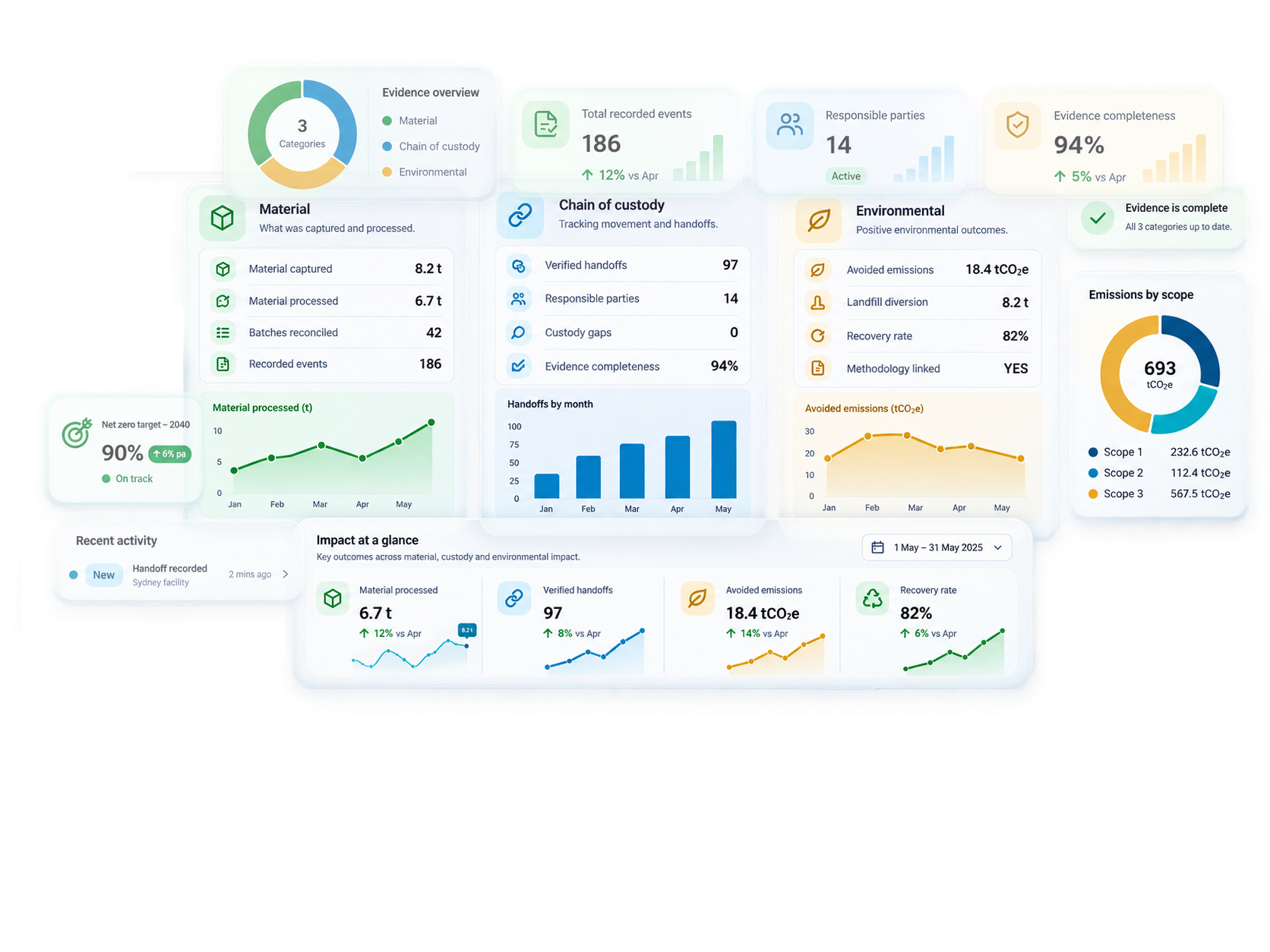
Captured at the event by the party that performed it, split by stream and attributed to site and period.
What each stream became, reported by the facility that processed it, with the residue recorded too.
Every figure drills back to its events, so the people who sign the report can see what they are signing.
When a director asks, “What is this Scope 3 number built on?” — is the answer a system or a person?
The year before your group's first disclosure is the cheapest year you will ever have to fix the data. Choose the next step that fits where you are.
Find answers to common questions and discover the best way to get started.
Start with one material pathway: its origin, destination, people involved and the evidence it needs to support. We then configure locations, roles and the records required at each handoff.
Not necessarily. REZET Hub is designed to complement existing operational, ERP, reporting and sustainability systems rather than requiring organisations to replace their existing technology stack.
Timing depends on the first pathway, sites, users and integration requirements. We confirm the implementation plan after scoping rather than promising a generic duration before we understand the operating reality.
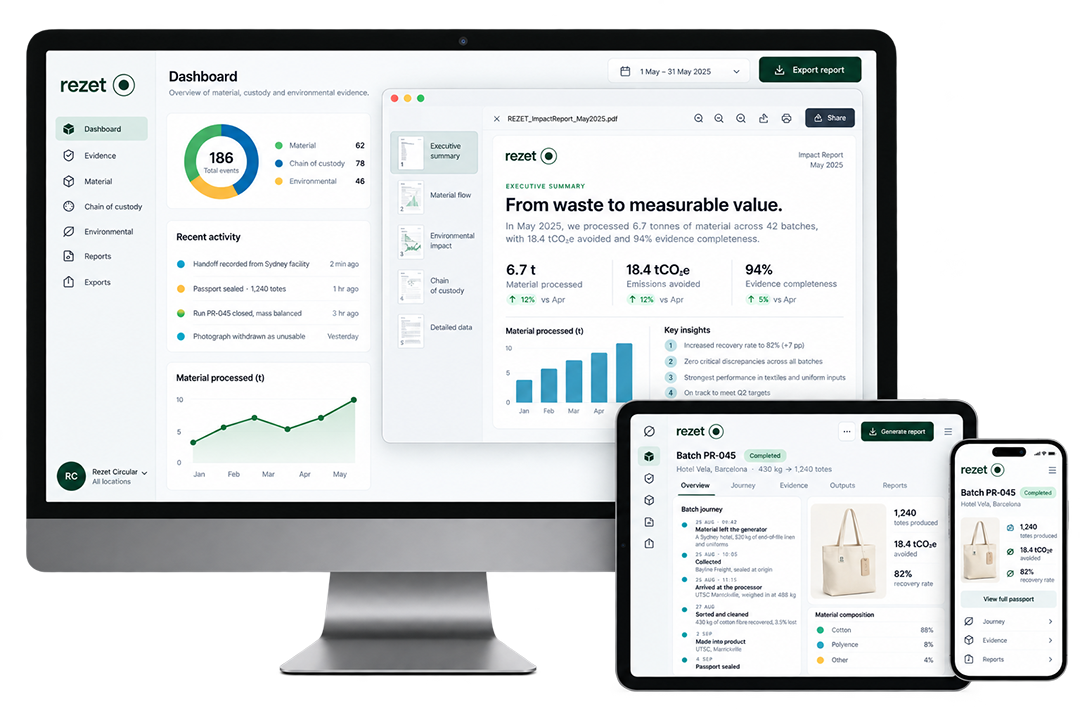
REZET Hub does not simply tell you what happened.
It helps you decide what should happen next.
Traditional reporting often relies on information entered after an event has occurred. REZET Hub is designed to capture evidence as materials move and responsibility changes, creating a stronger connection between the physical event and its digital record.
It also goes beyond reporting by acting as a sustainability decision-support tool. By analysing each waste stream, REZET Hub can identify alternative recovery, reuse, upcycling or recycling pathways, helping organisations improve circular outcomes and make more informed progress towards their zero-waste goals.
Explore is for one user testing one stream at one site. Operate supports a small team managing recurring batches and standard reports at one site. Scale adds multi-site controls and audit-grade Scope 3 outputs. Integrate is for advanced controls, SSO, API and broader organisational support.
REZET Hub is not a carbon-credit marketplace, a substitute for the physical operator, or a generic reporting tool that can reconstruct missing evidence after the fact. It works best when there is a real material flow and an internal owner prepared to make the record part of operations.
Yes. Start with one live pathway, then add users, sites, materials, reporting outputs or integrations as the programme grows. The right starting point is the smallest plan that can support the job properly.
Yes, on the record’s own terms. Handoffs are documented between responsible parties, processing events are linked to the relevant operator, and inputs and outputs are reconciled at batch level, so the same figures read supplier by supplier and site by site. Exports can be taken at any time in a structured format, for tenders, contract reviews and disputes.
Batch-level material identification, documented handoffs, processing events, responsible parties and input-output reconciliation. The result is a structured trail ready for review and export.
Yes. The evidence pack can support internal reporting, audits, customer requirements and Digital Product Passports. REZET Hub records the evidence; it does not replace the underlying regulatory obligation.
No. Where environmental outcomes are calculated, they stay linked to the underlying material record, methodology and supporting evidence rather than being presented as an offset.
Each responsible party records the handoff it took part in, and the receiving party measures the material independently on arrival and compares it against the sending party’s quantity, so any discrepancy becomes visible. Where the record and the movement disagree, the difference is surfaced as an exception instead of being smoothed over, and the underlying record is tamper-evident and append-only. Auditors and assurance providers come in as guests, on a read-only view of the trail. REZET Hub describes what the evidence contains, not what it certifies
Corrections are appended, not written over the top: every step becomes an event that is added to the record rather than replacing what was there. An auditor drilling into a claim sees the measurement, the actor, the evidence and the correction history behind it, which is why the record is never rewritten for the reader.
Capture begins from a material profile selected at source, with description, quantity and photographic evidence recorded against it; the receiving party then measures the material independently and reconciles the mass. The units and classifications your programme uses are agreed at onboarding, when we configure locations, roles and the records required at each handoff.
REZET Hub surfaces the exception and shows which party recorded which movement; it does not appoint the person inside your organisation who resolves it. REZET Hub works best when there is a real material flow and an internal owner prepared to make the record part of operations.
A contractor contributes evidence only where responsibility changes. Working from a scoped link, it sees the one job assigned to it and the quantity handed over, records the outputs, photographs or weighs them and submits. There is no shared login and no second reporting workflow: each party sees only the movements it took part in.
At the point of movement, the person handling the material selects the material profile, captures the description and quantity, and captures photographic evidence against it. There is no second reporting workflow: REZET Hub is designed to complement existing operational, ERP, reporting and sustainability systems rather than replace them.
Evidence is created at material handoffs and processing events rather than reconstructed afterwards, so a handoff that was never recorded stays visible as a gap in the batch trail. Where the record and the movement disagree, the difference is surfaced as an exception.REZET Hub is not a generic reporting tool that can reconstruct missing evidence after the fact: it shows the gap, it does not fill it.
REZET Hub began inside REZET Global’s circular programmes. Real materials were being recovered and transformed, while evidence sat across spreadsheets, emails, photographs and certificates. REZET Hub was built to keep the digital record in step with the physical work.
No. REZET Hub and REZET Global are separate businesses. REZET Hub can be used independently by organisations and circular operators. REZET Global provides one real-world operating environment in which REZET Hub’s evidence capabilities can be applied.
REZET Hub is available in English and Spanish, with Portuguese and German coming soon.
REZET Hub records the evidence; it does not replace the underlying regulatory obligation, and this page does not set out the rules of any single jurisdiction. Sites are managed as locations within one programme, and framework mapping detail is available on request — we describe what the evidence contains, not what it certifies. Which requirements apply at each site is scoped before implementation.