The sentence is written against a figure
A claim is registered as a statement plus the number it rests on. If the sentence says more than the number supports, the sentence changes.
You are probably here because legal asked what sits behind a sentence marketing already wrote.
A claim is only as good as the record you can open when someone tests it. And the ones that get tested are the broad ones, made without their conditions attached.
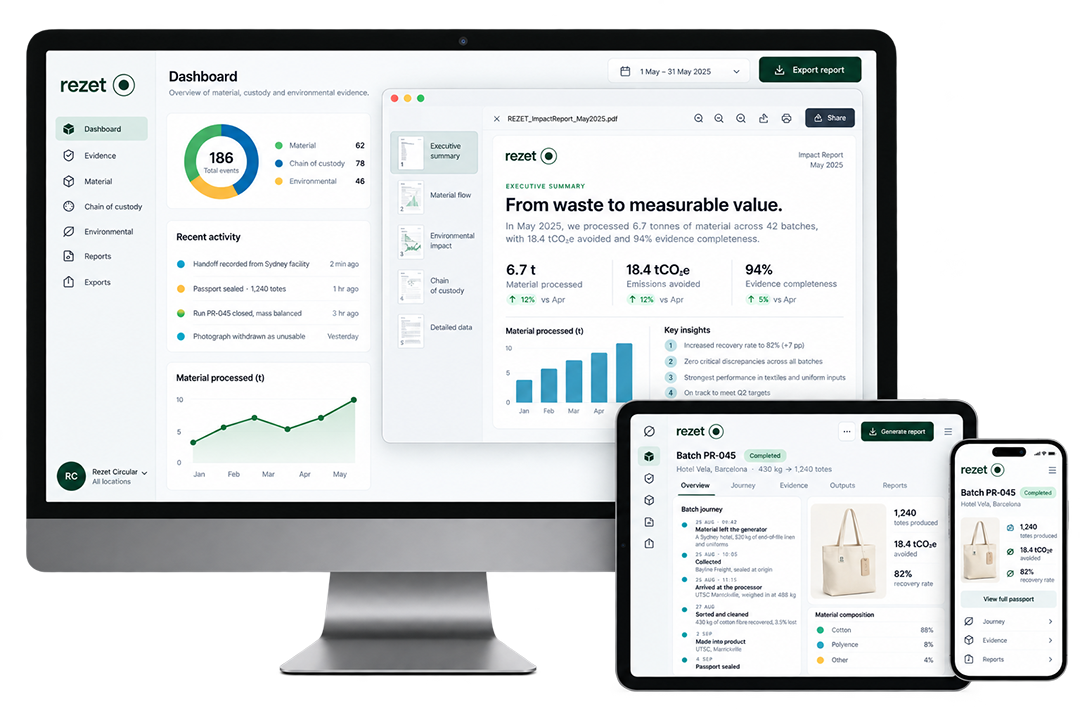
A claim is registered as a statement plus the number it rests on. If the sentence says more than the number supports, the sentence changes.
Scope and comparison are published with the statement. A percentage without its universe is not a claim, it is an impression.
Any number in a public statement drills back to the events that produced it: material, party, date and the evidence attached.
Unit, method and who performed the measurement travel with the figure, so a third party can follow the same steps.
What the evidence does not cover is recorded next to what it does. The gap is stated by us before it is found by someone else.
Substantiation is kept with its date. When a claim is tested later, what is opened is what existed when it was made.
What the evidence supports is decided before the wording is drafted.
Unit, scope and how it was measured, registered with the statement.
If the denominator weakens the claim, the claim changes. It does not move to a footnote.
Terms that need a file stay unavailable until the file exists.
So a statement made this year can be defended next year, as it stood.
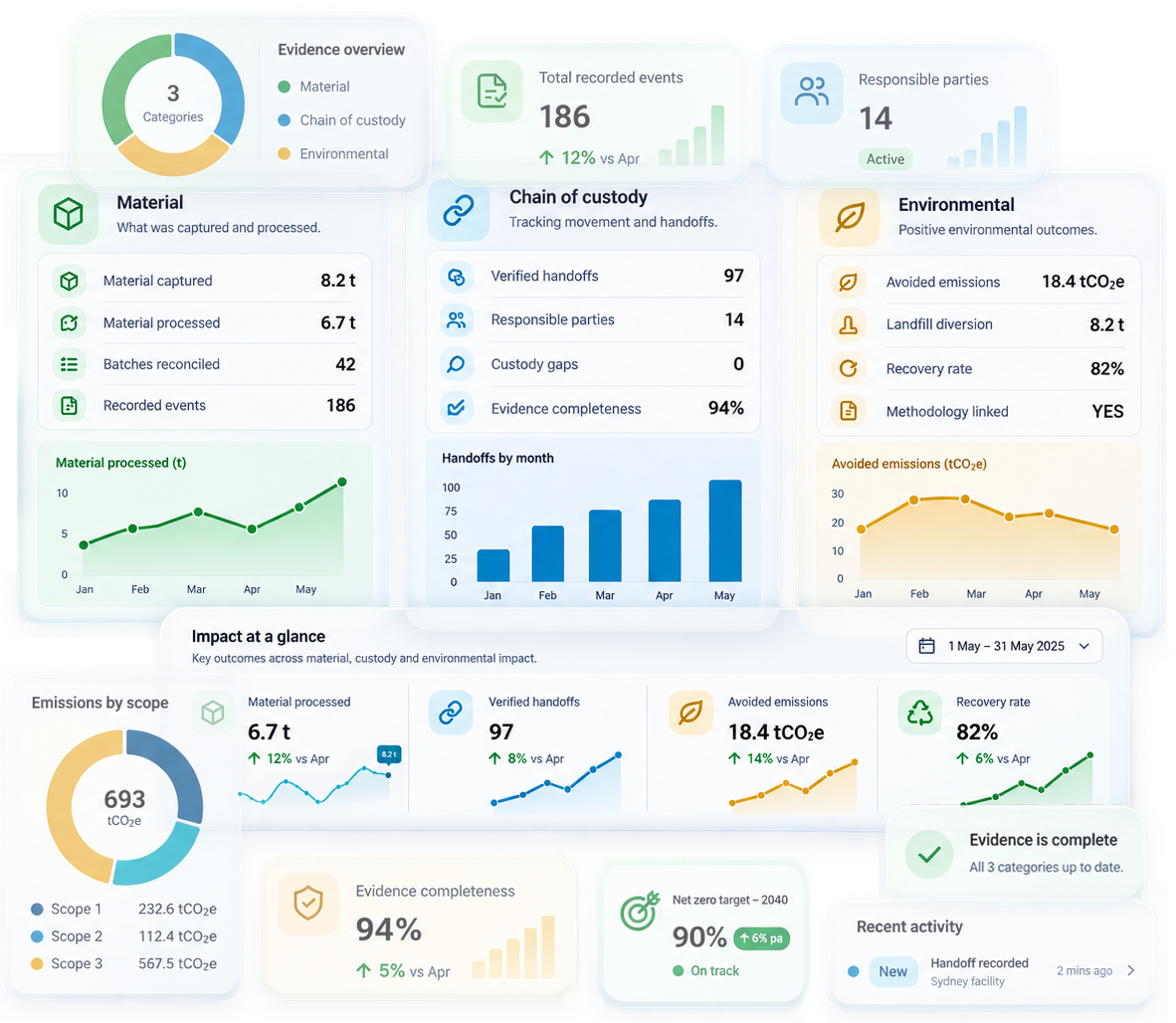
The statement, the figure, the method, the scope and the batches, held together and dated.
The limits travel with the sentence. What does not survive its own denominator does not go out.
Every public statement in one place, with what backs it, so a review is an afternoon and not an archaeology project.
When someone replies, “How do you know that?” — do you open a file or start an investigation?
A claim is cheap to support before it is published and very expensive to withdraw afterwards. Choose the next step that fits where you are.
Find answers to common questions and discover the best way to get started.
Start with one material pathway: its origin, destination, people involved and the evidence it needs to support. We then configure locations, roles and the records required at each handoff.
Not necessarily. REZET Hub is designed to complement existing operational, ERP, reporting and sustainability systems rather than requiring organisations to replace their existing technology stack.
Timing depends on the first pathway, sites, users and integration requirements. We confirm the implementation plan after scoping rather than promising a generic duration before we understand the operating reality.
REZET Hub does not simply tell you what happened.
It helps you decide what should happen next.
Traditional reporting often relies on information entered after an event has occurred. REZET Hub is designed to capture evidence as materials move and responsibility changes, creating a stronger connection between the physical event and its digital record.
It also goes beyond reporting by acting as a sustainability decision-support tool. By analysing each waste stream, REZET Hub can identify alternative recovery, reuse, upcycling or recycling pathways, helping organisations improve circular outcomes and make more informed progress towards their zero-waste goals.
Explore is for one user testing one stream at one site. Operate supports a small team managing recurring batches and standard reports at one site. Scale adds multi-site controls and audit-grade Scope 3 outputs. Integrate is for advanced controls, SSO, API and broader organisational support.
REZET Hub is not a carbon-credit marketplace, a substitute for the physical operator, or a generic reporting tool that can reconstruct missing evidence after the fact. It works best when there is a real material flow and an internal owner prepared to make the record part of operations.
Yes. Start with one live pathway, then add users, sites, materials, reporting outputs or integrations as the programme grows. The right starting point is the smallest plan that can support the job properly.
Yes, on the record’s own terms. Handoffs are documented between responsible parties, processing events are linked to the relevant operator, and inputs and outputs are reconciled at batch level, so the same figures read supplier by supplier and site by site. Exports can be taken at any time in a structured format, for tenders, contract reviews and disputes.
Batch-level material identification, documented handoffs, processing events, responsible parties and input-output reconciliation. The result is a structured trail ready for review and export.
Yes. The evidence pack can support internal reporting, audits, customer requirements and Digital Product Passports. REZET Hub records the evidence; it does not replace the underlying regulatory obligation.
No. Where environmental outcomes are calculated, they stay linked to the underlying material record, methodology and supporting evidence rather than being presented as an offset.
Each responsible party records the handoff it took part in, and the receiving party measures the material independently on arrival and compares it against the sending party’s quantity, so any discrepancy becomes visible. Where the record and the movement disagree, the difference is surfaced as an exception instead of being smoothed over, and the underlying record is tamper-evident and append-only. Auditors and assurance providers come in as guests, on a read-only view of the trail. REZET Hub describes what the evidence contains, not what it certifies
Corrections are appended, not written over the top: every step becomes an event that is added to the record rather than replacing what was there. An auditor drilling into a claim sees the measurement, the actor, the evidence and the correction history behind it, which is why the record is never rewritten for the reader.
Capture begins from a material profile selected at source, with description, quantity and photographic evidence recorded against it; the receiving party then measures the material independently and reconciles the mass. The units and classifications your programme uses are agreed at onboarding, when we configure locations, roles and the records required at each handoff.
REZET Hub surfaces the exception and shows which party recorded which movement; it does not appoint the person inside your organisation who resolves it. REZET Hub works best when there is a real material flow and an internal owner prepared to make the record part of operations.
A contractor contributes evidence only where responsibility changes. Working from a scoped link, it sees the one job assigned to it and the quantity handed over, records the outputs, photographs or weighs them and submits. There is no shared login and no second reporting workflow: each party sees only the movements it took part in.
At the point of movement, the person handling the material selects the material profile, captures the description and quantity, and captures photographic evidence against it. There is no second reporting workflow: REZET Hub is designed to complement existing operational, ERP, reporting and sustainability systems rather than replace them.
Evidence is created at material handoffs and processing events rather than reconstructed afterwards, so a handoff that was never recorded stays visible as a gap in the batch trail. Where the record and the movement disagree, the difference is surfaced as an exception.REZET Hub is not a generic reporting tool that can reconstruct missing evidence after the fact: it shows the gap, it does not fill it.
REZET Hub began inside REZET Global’s circular programmes. Real materials were being recovered and transformed, while evidence sat across spreadsheets, emails, photographs and certificates. REZET Hub was built to keep the digital record in step with the physical work.
No. REZET Hub and REZET Global are separate businesses. REZET Hub can be used independently by organisations and circular operators. REZET Global provides one real-world operating environment in which REZET Hub’s evidence capabilities can be applied.
REZET Hub is available in English and Spanish, with Portuguese and German coming soon.
REZET Hub records the evidence; it does not replace the underlying regulatory obligation, and this page does not set out the rules of any single jurisdiction. Sites are managed as locations within one programme, and framework mapping detail is available on request — we describe what the evidence contains, not what it certifies. Which requirements apply at each site is scoped before implementation.